Rural Buildings
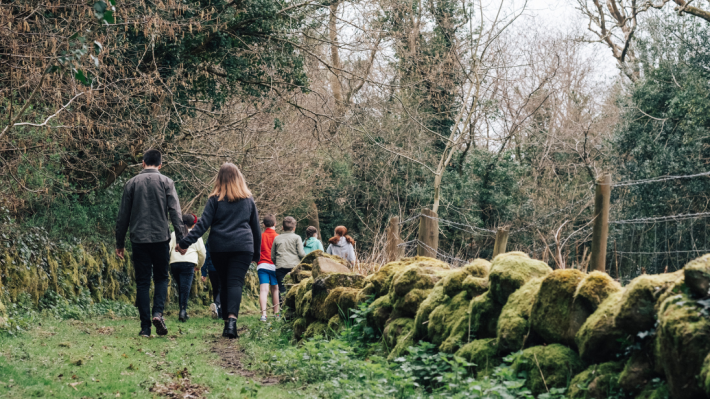
Stroll through the rural area with its working farms and cottages and discover a wonderful natural environment of over 60 acres steeped in history.
Ballydown National School
Ireland's National School system was established in 1831 with the joint aims of making literate the mass of the population and of educating together children of all religious denominations. There was provision for separate religious education, outside normal school hours, by the various ministers...
More...
Ballydugan Weavers House
This is a linen weaver's dwelling and workshop. Handloom weavers had to work long hours to produce sufficient cloth to earn a decent livelihood. An exhaustive record search shows that there was no land attached to this house, just a small garden, so weaving was the family's only source of income....
More...
Ballyveagh Farm
This farm had been home to four generations of the Baird family, until shortly before being acquired by the Ulster Folk & Transport Museum in the late 1980s. The property, built of Mourne granite in the 1840s, was moved from its location in the Mourne Mountains in south County Down.
T...
More...
Coalisland Spade Mill
Throughout much of Ireland, the spade was the main tool of cultivation, not the plough. Different shapes of spades were used in different parts of Ireland. Most spade mills were in Ulster, because Southern spade blades, being open, required no welding and were made by local blacksmith...
More...
Corradreenan Farmhouse
This is the farm and dwelling of a prosperous farming family, the Elliott family, who lived here since at least the early 1800s. The exact date of construction is impossible to determine but a William Elliott was born in this house in 1802. In those days it was a simple two-roomed house, a kitche...
More...
Coshkib Hill Farm
This house had a fine reputation as a local ceilidh house - a house noted for informal social occasions of story-telling, conversation, discussion, music-playing and singing. It was the home of the Hyndman family. In 1900 Dan Hyndman and his wife, Margaret, lived in the house and worked the...
More...
Cruckaclady Farmhouse
This farmhouse was built during the 19th century as one of an irregular cluster of dwellings called a clachan. It very cleverly used the lie of the land to include a byre under the bedroom. This saved considerably on the materials and labour needed to provide shelter for both humans and ani...
More...
Drumnahunshin Farm
The Patterson family lived at Drumnahunshin from the 1830s when this house was built, until the 1960s, when the last occupant, Miss Maggie Patterson, died. Miss Maggie's niece, Mrs Gay Patterson Komich of Hillsborough, California, inherited the property and presented it to the Museum.
Orig...
More...
Duncrun Cottiers House
Cottiers were landless peasants who survived precariously close to the bottom of the social scale. They only became numerically important in the middle of the 18th century due to population growth and increased pressure for land. Cottiers rented a house, usually a one-roomed cabin built of sods, ...
More...
Gorticashel Flax-scutching Mill
Scutching is the process of extracting linen fibres from flax stems. Working in a scutch mill was a highly dangerous occupation. Scutchers were at risk from machinery that could not be stopped quickly in an emergency; the air was thick with unhealthy dust and there was an ever-present dange...
More...
Ask an Expert
If you would like further information about this collection you may contact the
curator by following this link and
completing the short form.